
language
How Does a Roll Forming Machine Determine Profile Length and Cutting Position?
07 Sep
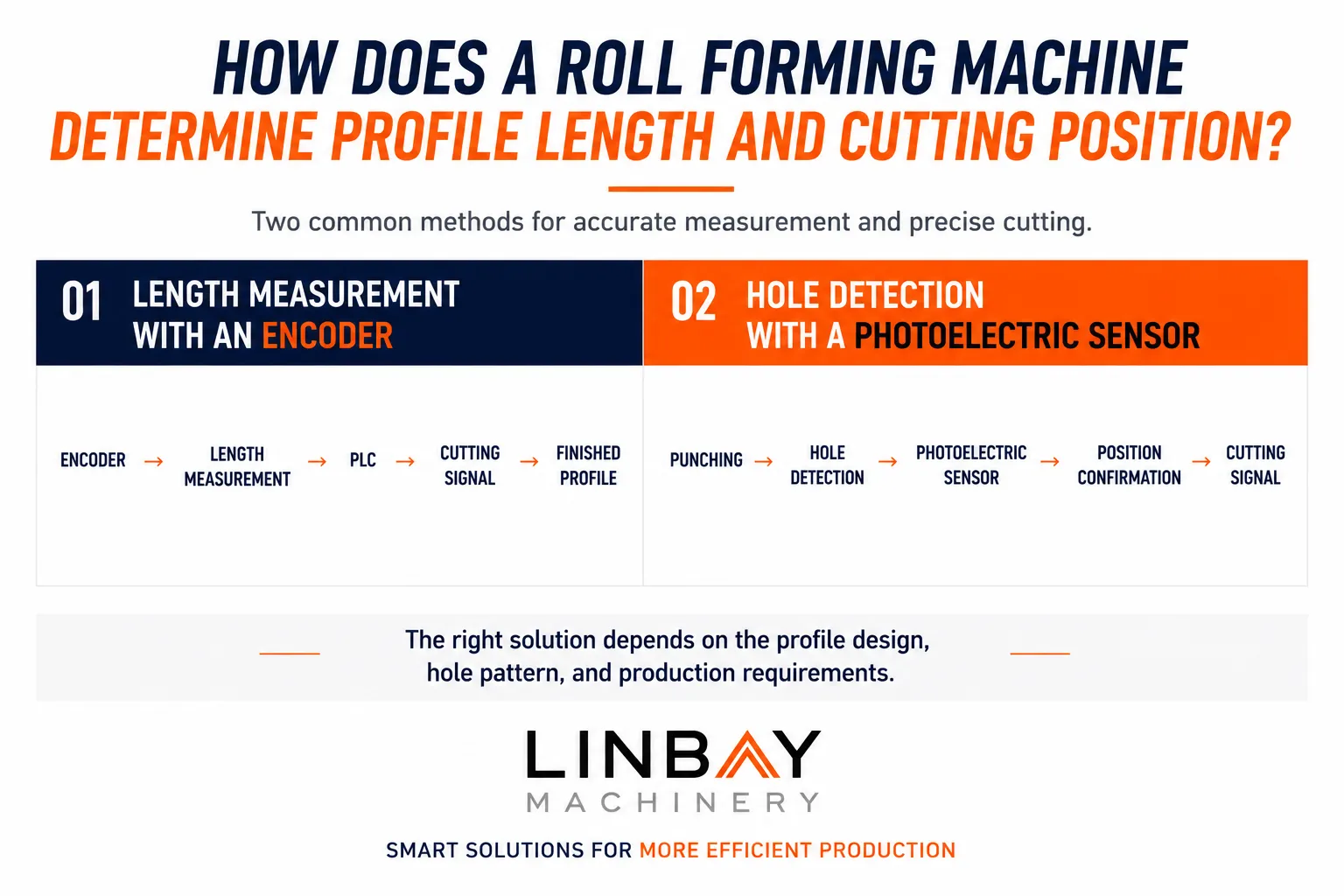
When a customer sets a production length of 6 meters, a simple question arises: how does the machine know exactly when to cut the profile?
Behind every automatic cutting operation is a measurement and control system that determines either the profile length or the correct cutting position.
Depending on the profile design and punching requirements, different methods can be used. Two common solutions are length measurement with an encoder and hole detection with a photoelectric sensor.
1. Length Measurement with an Encoder
An encoder is commonly used to measure profile length during roll forming.
As the profile moves through the production line, the encoder measures its travel distance and sends the data to the PLC. The control system continuously compares the measured length with the value entered by the operator.
For example, if the required length is 6 meters, once the preset length is reached, the PLC sends a signal to the cutting system.
The process can be summarized as:
Encoder → Length Measurement → PLC → Cutting Signal → Finished Profile
This method makes it easy to produce profiles in different lengths by changing the corresponding settings in the control system.
2. Hole Detection with a Photoelectric Sensor
An encoder is not the only way to determine where a profile should be cut.
For certain profiles with frequent or regularly arranged holes, a photoelectric sensor can detect the punched holes and use them as a reference for the cutting position.
As the punched profile moves through the line, the sensor detects the holes. The control system uses this information to identify the required position and coordinate the cutting operation.
The process can be simplified as:
Punching → Hole Detection → Photoelectric Sensor → Position Confirmation → Cutting Signal
This method is particularly useful for certain profile designs where the hole pattern provides a suitable reference for determining the cutting position.
Which Method Is More Suitable?
There is no single measurement method that is ideal for every roll forming line.
The right solution depends on several factors, including the profile design, hole pattern, required length, and production requirements.
For some projects, encoder-based length measurement provides a simple and efficient solution. For profiles with specific punching patterns, photoelectric hole detection may be a more suitable option.
A Solution Designed for Each Profile
At LINBAY, we do not simply apply the same configuration to every roll forming machine. We analyze each customer's profile and production requirements to determine the appropriate measurement and control solution.
From length measurement to cutting position detection, every detail contributes to the accuracy and efficiency of the complete production line.
Behind every accurately cut profile is more than just a cutting unit—it is the result of measurement, detection, and control systems working together.

Recent Posts

October 26, 2016
The Most Successful Engineering Contractor
20 Jan
Business Developing
Contact US
Product Information
Quantity
Unit
Piece
Support order samples, customization, wholesale direct, and complete payment. If the product you look for does not have corresponding customized content, pls fill out the form below to contact us, and we will reply ASAP.